Most customers meet a brand several times before they buy. They hear a podcast read, see a short video, search the brand name, and finally check out, often on a different platform than the one that first caught their attention. Multi-channel attribution is how you connect that whole path to the sale.
Why single-channel reporting misleads
Every ad platform reports conversions from its own point of view. Meta sees Meta clicks, Google sees Google clicks, and neither sees the podcast or the in-store purchase. Add the platforms' numbers together and you usually get more conversions than you actually had, because several platforms claim the same sale.
Web analytics has the opposite blind spot: it only sees your website. An Amazon order, a Walmart marketplace sale or a purchase at the register never touches your site, so it never shows up.
Multi-channel attribution fixes both problems by holding both sides in one place: touchpoints from every channel, and orders from every store.
How multi-channel attribution works
- Collect touchpoints. A first-party tracking snippet records ad clicks, UTM tags and referrers on your site. Channels with no web click, such as podcasts, email, SMS and TV, are sent server-side.
- Collect sales. Orders arrive from store connections, CSV exports or an API, from every platform you sell on.
- Match them. Each sale is linked to the touchpoints before it using shared keys: an ad click ID, a hashed email, or the same network and device.
- Split the credit. An attribution model decides how much each touchpoint earns.
Which attribution model should you use?
There is no single correct model, which is why it helps to switch between them:
- Last touch credits the final touchpoint. It is good for spotting what closes sales.
- First touch credits the first. It is good for spotting what creates demand.
- Linear splits credit evenly. It is a fair default when several channels work together.
We compare them in detail in first touch vs last touch vs linear attribution.
What makes a match trustworthy
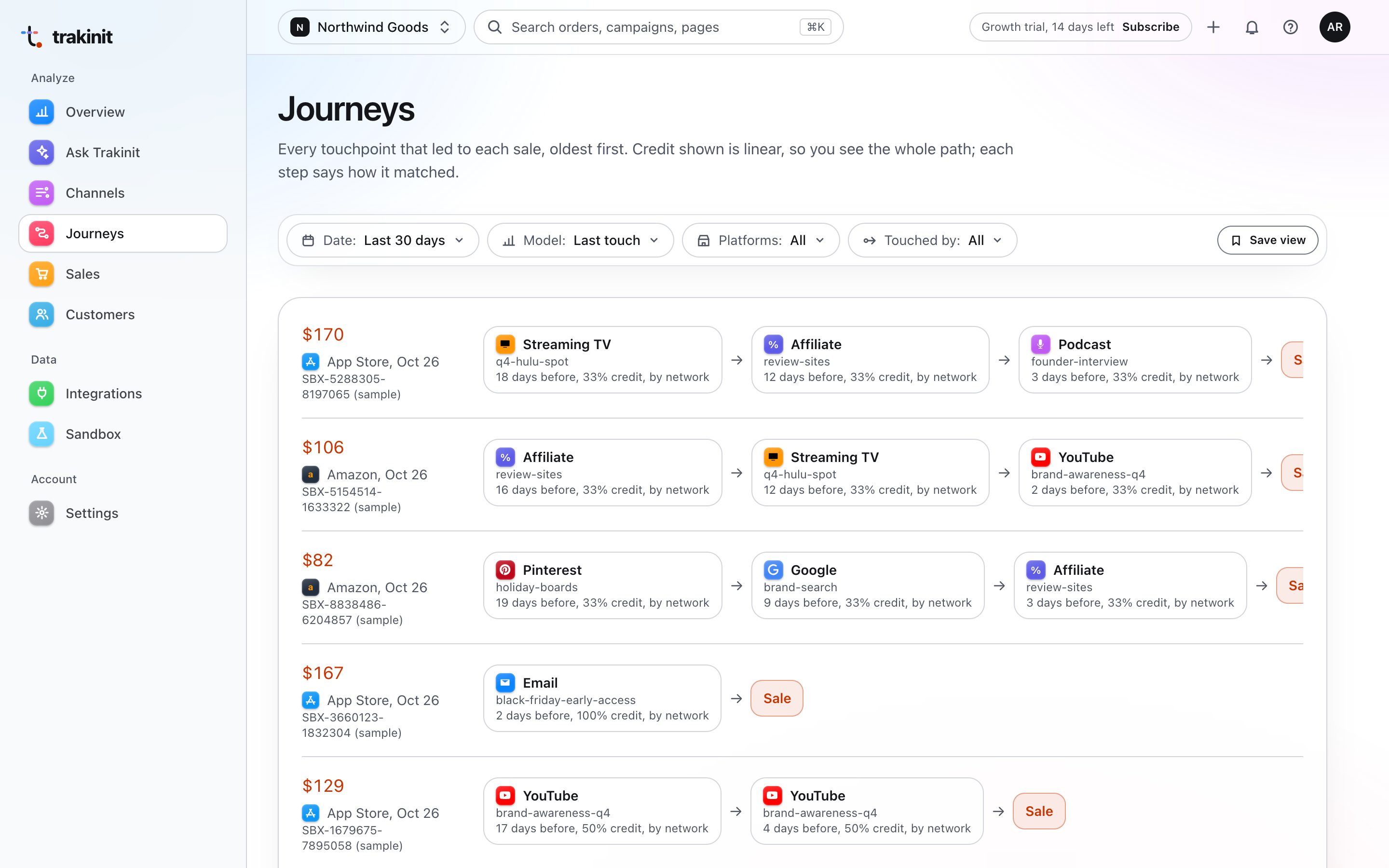
Not every match is equally certain. A sale that carries the same click ID as an earlier ad click is an exact match. A sale that only shares a network with an earlier visit is an estimate. Good attribution tools tell you which is which. In Trakinit every match carries a confidence score, and exact keys always win over network estimates.
Measuring sales that happen off your website
The biggest gap in most attribution setups is off-site revenue. If you sell on Amazon, Walmart or in physical stores, your website analytics cannot see those sales at all. A multi-channel approach brings those orders in directly, so a TikTok video can get credit for an Amazon order and a podcast read for a sale at the register. Read more in our guides to Amazon attribution and in-store attribution.
Getting started
Frequently asked questions
What is the difference between multi-channel and multi-touch attribution?
Multi-touch attribution credits several touchpoints in one journey. Multi-channel attribution emphasizes that those touchpoints span different channels and that sales happen on different platforms. In practice the terms overlap.
Do small brands need multi-channel attribution?
If you spend on more than one channel, or sell in more than one place, yes. Otherwise you're relying on each platform's own, overlapping claims.
How is this different from marketing mix modeling?
Attribution works sale by sale. Marketing mix modeling works from aggregate trends. Read how to choose attribution software for when each fits.
You can set up multi-channel attribution in an afternoon: add a script tag, bring in your orders, and connect an ad account for spend. Trakinit's quick-start guide walks through each step, and the 14-day trial needs no credit card. Start a free trial.